
What Is an Agency Operating Cadence? A Week in the Life of Your Managed Amazon Channel
An agency operating cadence is the structured, repeatable rhythm of daily and weekly actions an Amazon account management team executes to keep an active channel profitable, compliant, and defensible. It is not a meeting schedule. It is a synchronized operational system that binds advertising decisions, inventory health, listing compliance, and P&L accountability into a single weekly execution loop.
A managed Amazon channel runs on three interlocking layers. Daily Operational Execution covers high-frequency actions that cannot wait for a weekly review — ad spend pacing, inventory replenishment flags, listing suppression alerts, and bid adjustments tied to real-time stock levels. Bi-Weekly Strategic Review is the structured mid-cycle assessment where advertising performance is evaluated against total channel revenue, not campaign-level metrics alone. Monthly P&L Accountability Audit is where the full picture comes together — contribution margin, channel defense performance, unauthorized seller exposure, and forward adjustments for the month ahead.
Three recurring checkpoints anchor the weekly execution cycle. The Ad Spend and Inventory Alignment Check runs at the start of the week to prevent advertising dollars from running against products that cannot fulfill demand. The Listing Health and Compliance Review occurs mid-week to catch suppressions, content violations, and competitive threats before they compound. The Performance Synthesis and Strategic Adjustment closes the week by reconciling advertising efficiency against total channel revenue — using TACoS as the primary signal, not ACoS in isolation.
This cadence matters because the Amazon marketplace is not a passive distribution channel. Third-party sellers command 60% of all platform sales, which means competition for organic visibility, pricing integrity, and conversion is continuous. Stockouts of more than 14 consecutive days can degrade organic listing visibility by up to 50%. A daily proactive monitoring protocol can reduce the risk of unexpected listing suppressions by 90%. These outcomes are not produced by end-of-month reporting. They are produced by a disciplined operational cadence executed every single week.
Last Updated: June 12, 2026
- • Why Most Amazon Agencies Don't Actually Have a Cadence
- • The Daily Rhythm: What Happens Inside a Managed Channel Every 24 Hours
- • The Weekly Operating Cadence: What a Full Seven-Day Cycle Covers
- • What the 3P360 Client Data Dashboard Makes Possible
-
• Frequently Asked Questions
- • What is an agency operating cadence for Amazon account management?
- • How often should inventory levels be reconciled with Amazon advertising campaigns?
- • What weekly health checks are required to maintain a secure Amazon storefront?
- • Why do daily ad budget adjustments matter more than end-of-month reporting?
- • How does a client data dashboard like 3P360 improve the weekly cadence?
- • The Cadence Is the Accountability
Why Most Amazon Agencies Don't Actually Have a Cadence

Most Amazon agencies don't have a cadence. They have a reporting schedule. Those are not the same thing.
A reporting schedule looks backward. It collects what happened last month and packages it in a slide deck.
A cadence looks forward. It executes daily actions that stop margin erosion before it ever shows up on the P&L.
One model produces documentation. The other produces results.
The reporting model won because it's easier to sell. It looks like accountability. A slide deck with last month's numbers feels like proof of work — and most brands don't realize they're paying for documentation until the P&L tells them otherwise.
Brands running at scale don't need a prettier version of what already happened. They need an operational partner executing decisions every single day the channel is live — which is exactly what full channel management delivers and what a reporting-only agency structurally cannot.
Why the Reporting-Only Model Fails Your P&L
Here's what the failure sequence looks like. An agency checks metrics at end of month. By then, a listing suppression that hit in week two has already eroded two weeks of organic velocity.
An inventory gap that should have triggered an advertising pause instead ran full spend against a product that couldn't fulfill demand.
The P&L absorbs those losses quietly. The report just shows the result.
The metric choice makes it worse. An agency optimizing ACoS in isolation can hand you a low ACoS on a channel that's actively stagnating. The number looks healthy. The business isn't moving.
TACoS — Total Advertising Cost of Sale measured against total channel revenue — is the metric that tells the real story. As Justin W. Boggs wrote in Forbes, tracking TACoS as the primary benchmark uncovers structural channel profitability that isolated campaign metrics simply cannot reveal. ACoS tells you how efficiently your ads are working. TACoS tells you whether the channel is actually building anything.
That's how an agency reports good numbers while the brand's contribution margin quietly shrinks. It's not dishonesty. It's a structural failure — optimizing the wrong metric, at the wrong frequency, inside an accountability model that rewards reporting over execution.
Organizations running disciplined operational cadences see up to a 30% boost in overall operational efficiency. Agencies running monthly review cycles don't capture that advantage.
Neither do their clients.
The Amazon Account Management model that actually moves the P&L has to operate at the frequency the channel demands — not the frequency that's convenient to schedule.
Waiting until month-end to review a channel that runs 24 hours a day, seven days a week, is not a strategy.
It's a choice to absorb preventable losses.
| Agency Model | Primary Activity | Reporting Frequency | P&L Accountability |
|---|---|---|---|
| Reporting-Only Agency | Compiles metrics from the prior period and presents findings in a scheduled review | Monthly or quarterly | None — outcomes are documented after the fact, not prevented |
| Task-Execution Agency | Completes assigned deliverables (ad management, listing updates) without owning channel outcomes | Weekly task completion logs | Limited — accountability is tied to task delivery, not P&L performance |
| Channel Management with Daily Cadence | Executes synchronized daily and weekly operational actions across advertising, inventory, and listing compliance | Daily operational execution with bi-weekly strategic review and monthly P&L audit | Full — outcomes are measured against contribution margin and total channel revenue |
| Reactive Optimization Agency | Responds to performance drops after they register in campaign dashboards | Ad hoc — triggered by alerts or client escalations | Partial — addresses symptoms after margin erosion has already occurred |
The Daily Rhythm: What Happens Inside a Managed Channel Every 24 Hours

Here's what a live Amazon channel produces every 24 hours: bid performance shifts, inventory run-rate changes, listing health flags, suppression triggers.
Those signals don't wait for anyone. They accumulate — acted on or not.
The only question that matters is whether someone catches them the day they appear.
Most agencies don't see those signals until end of month.
By then, a suppressed listing has already burned two weeks of organic velocity. An inventory gap has already pushed full ad spend against a product that couldn't ship. The losses are baked in.
The report just shows the damage.
So the daily cadence runs on three fixed intervention points across the week — each one targeting a specific failure mode.
Not flexible. Not approximate. Fixed.
Because the channel doesn't take days off, and the cadence can't either.
Day 1: Ad Spend and Inventory Alignment Check
The week opens with the Ad Spend and Inventory Alignment Check — and that sequence is deliberate.
Ad spend decisions made without current inventory data aren't optimization. They're spending money against products that might not be able to ship.
When advertising runs disconnected from real-time inventory run-rates, the capital depletes without building any product velocity. That's not a small inefficiency.
It's margin erosion on autopilot — and it runs every day the check doesn't happen.
The Day 1 review stops that before the week builds any momentum. The mechanics behind it are documented in this inventory-ad alignment model.
- Active bid pacing reviewed against real-time in-stock status for every ASIN
- Replenishment lead times flagged against projected sell-through rates
- ASIN-level bid suppression triggered by low inventory thresholds identified and adjusted
- Spend pulled back before a stockout — not after it
Day 3: Listing Health and Compliance Review
By mid-week, the focus moves to the Listing Health and Compliance Review — the part of channel management most agencies skip because it doesn't show up in a campaign dashboard.
Listing suppressions, content violations, and unauthorized seller activity don't send alerts. They compound quietly. A brand typically finds out when the revenue drop is already a week old and the damage has been running the whole time.
Stockouts beyond 14 consecutive days can degrade organic listing visibility by up to 50%. Compliance-triggered suppressions hit just as hard — and they arrive without warning.
The Day 3 review catches both. It's a systematic sweep of listing status, content integrity, and pricing signals across the full catalog.
A daily proactive monitoring protocol reduces the risk of unexpected suppressions by up to 90%. That number doesn't come from a month-end report. It comes from showing up every single week.
And this is where unauthorized seller activity gets flagged before the weekend.
A brand with strong products and zero monitoring isn't just losing margin. It's training its own customers to expect the lower price the unauthorized seller is charging.
That's a brand problem. The mid-week review doesn't let it run undetected.
Day 5: Performance Synthesis and Strategic Adjustment
The week closes with the Performance Synthesis and Strategic Adjustment.
This is where execution gets measured against outcome. Not campaign outcome. Total channel outcome.
There's a difference — and it's the difference between a healthy P&L and a good-looking dashboard.
TACoS is doing the real work here — not ACoS.
Tracking TACoS as the primary advertising benchmark surfaces structural channel profitability that isolated campaign metrics never show. An ACoS that looks clean while TACoS is climbing isn't a win. It's a warning that organic velocity is eroding and the brand is leaning harder on paid to compensate.
The Day 5 synthesis catches that misread every week — before it becomes next month's problem.
- Bid strategy reset for the following week based on channel performance
- ASIN-level spend allocation adjusted against current organic velocity
- Suppression and compliance issues from mid-week escalated or resolved
- Operational posture confirmed — not a stack of unreviewed data waiting for a monthly deck
| Cadence Day | Primary Focus Area | Key Action Taken | P&L Impact If Skipped |
|---|---|---|---|
| Day 1 — Ad Spend and Inventory Alignment Check | Advertising budget allocation vs. real-time inventory status | Active bid pacing reviewed against in-stock levels; replenishment lead times flagged against projected sell-through; ASIN-level bid suppression triggered where inventory thresholds are low | Ad spend runs against products that cannot fulfill demand — depleting marketing capital without building product velocity or organic rank |
| Day 3 — Listing Health and Compliance Review | Catalog integrity, suppression risk, and unauthorized seller activity | Full sweep of listing status and content compliance; pricing signal monitoring for MAP violations; unauthorized seller flags raised and escalated | Suppression events and pricing erosion compound undetected — eroding organic velocity and training customers to expect below-MAP prices before the brand notices the drop |
| Day 5 — Performance Synthesis and Strategic Adjustment | Total channel performance vs. advertising efficiency | TACoS reviewed against ACoS to assess true channel health; bid strategy adjusted for the following week; ASIN-level spend reallocated based on organic velocity and suppression status | Week closes without a corrected operational posture — misreads in advertising efficiency carry forward into the next cycle and compound on the monthly P&L |
The Weekly Operating Cadence: What a Full Seven-Day Cycle Covers

The cadence runs on three layers — each operating at a different frequency, each serving a different function.
Daily Operational Execution is the tactical engine. Bi-Weekly Strategic Review is the diagnostic checkpoint. Monthly P&L Accountability Audit is where the channel's real financial health gets measured against targets.
Three layers. One synchronized system.
These layers don't operate independently. They compound.
The daily execution layer catches problems before they erode margin. The bi-weekly layer validates whether that daily execution is producing directional momentum — or just activity. The monthly layer asks the harder question: is the channel actually profitable, and are we protecting what the brand already built?
Organizations running disciplined operational cadences see up to a 30% boost in overall operational efficiency.
That doesn't come from better dashboards. It comes from intervention at the right frequency — daily, not monthly.
Cadence produces that result. Reporting schedules don't.
Weekly Layer 1: Daily Operational Execution
Daily Operational Execution is not a monitoring posture.
It is an intervention posture.
Monitoring sees a problem and records it. Execution sees a problem and resolves it the same day it surfaces. That difference is the entire gap between an agency that reports damage and one that prevents it.
Three checkpoints anchor the daily layer across the week — the Ad Spend and Inventory Alignment Check, the Listing Health and Compliance Review, and the Performance Synthesis and Strategic Adjustment.
Each one targets a specific category of channel risk. None of them wait for month-end to act on what they find.
That's the design. Problems get resolved at the frequency they occur — not at the frequency that's convenient to schedule.
A daily proactive monitoring protocol cuts the risk of unexpected listing suppressions by 90%.
That outcome doesn't happen at monthly review cadence. It only happens when someone is looking every single day.
The gap between those two approaches is exactly what proactive monitoring produces — and it shows up on the P&L whether or not anyone is tracking it.
Weekly Layer 2: Bi-Weekly Strategic Review
Bi-Weekly Strategic Review operates at a different altitude.
Where the daily layer executes, the bi-weekly layer evaluates.
The question it answers isn't whether the work is getting done. It's whether the work is getting done in the right direction.
This is where TACoS trends get examined across a two-week window. Catalog-level advertising efficiency gets compared against organic velocity signals. Budget allocation gets tested against what the category is actually doing.
Third-party sellers command roughly 60 percent of all platform sales. That competitive density doesn't pause between monthly check-ins.
Neither does this layer.
Weekly Layer 3: Monthly P&L Accountability Audit
Monthly P&L Accountability Audit is the layer most agencies claim to provide.
Few actually deliver it.
The word accountability is the operative one.
A performance report tells you what happened. That's not this.
The Monthly P&L Accountability Audit measures contribution margin. It evaluates whether the defensive work — unauthorized seller enforcement, MAP compliance, listing integrity — held its ground. Then it sets operational priorities for the month ahead.
That's a completely different job. And most agencies aren't doing it.
The monthly layer is where the 3P360 client data dashboard delivers its most concentrated value — pulling daily execution data and bi-weekly diagnostic signals into one unified view of channel P&L.
Not a collection of campaign metrics. A full accounting of whether the channel is building equity or eroding it.
Knowing what happened is table stakes. Understanding what it means for the month ahead — that's the work.
| Cadence Layer | Frequency | Primary Deliverable | Who Reviews It | P&L Metric Tracked |
|---|---|---|---|---|
| Daily Operational Execution | Every business day (3 anchored checkpoints per week) | Resolved listing suppressions, adjusted bids, inventory-aligned ad spend | Account management team | Daily TACoS movement, listing health status, in-stock rate |
| Bi-Weekly Strategic Review | Every two weeks | Directional assessment of catalog efficiency, organic velocity trends, and budget allocation | Account lead and brand counterpart | TACoS trend across two-week window, organic vs. paid revenue split |
| Monthly P&L Accountability Audit | Once per month | Full channel contribution margin review, defensive strategy scorecard, forward operating priorities | Senior account team and client leadership | Contribution margin, MAP compliance health, unauthorized seller exposure, net channel profitability |
What the 3P360 Client Data Dashboard Makes Possible
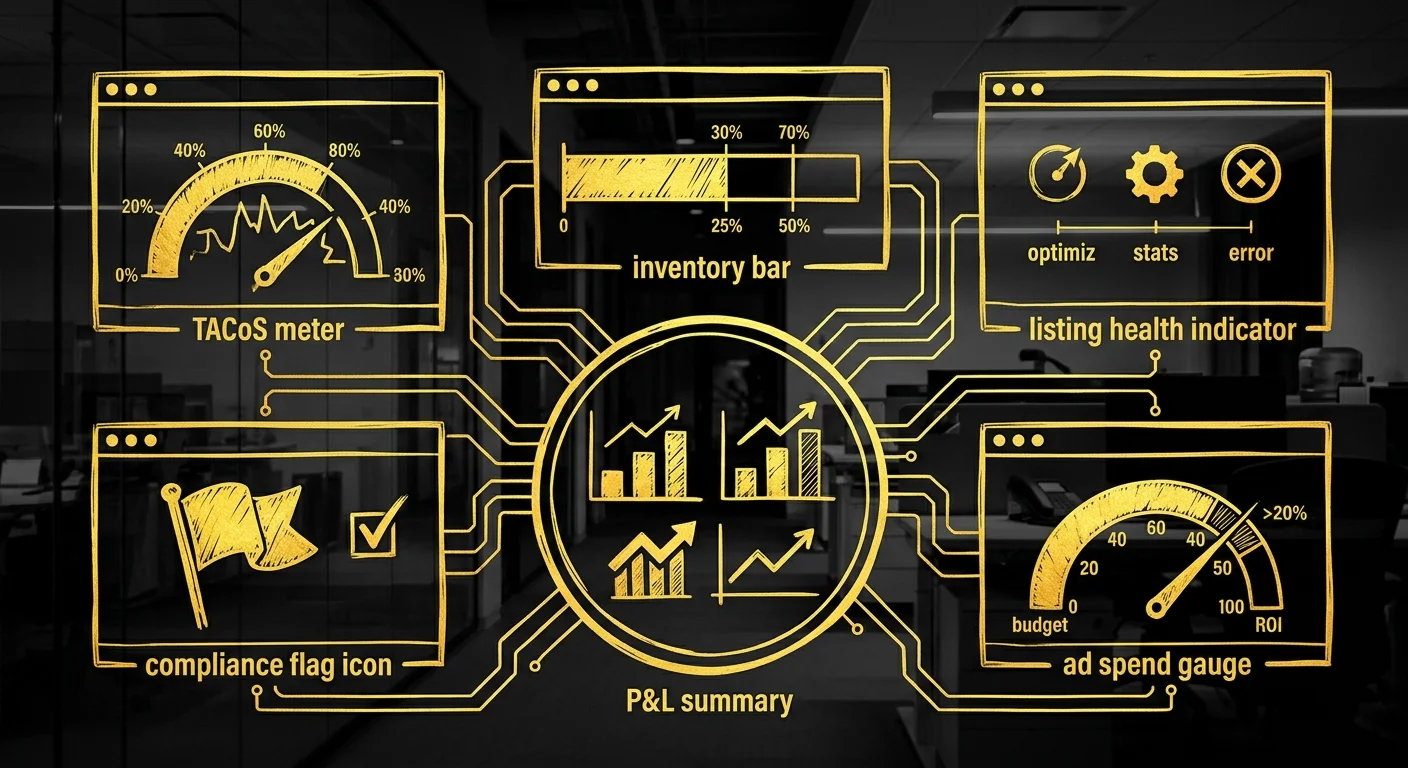
The cadence generates signal constantly.
Bid pacing decisions. Inventory flags. Suppression events. Compliance triggers. TACoS trend movements. That data is worthless if it surfaces in a slide deck 30 days after the decisions were already made.
That's what 3P360 was built to prevent.
Most agency reporting tools show campaign-level outputs. They tell a brand what its ACoS was last week.
That's the whole picture, as far as those tools are concerned.
They don't tell a brand whether the channel is building or eroding. They don't connect daily execution actions to P&L outcomes. Tracking TACoS as the primary advertising benchmark uncovers structural channel profitability margins that isolated campaign metrics fail to reveal.
3P360 closes that gap by design — not as a feature, but as the foundational premise.
3P360 pulls every cadence layer into one place.
Daily Operational Execution data. Bi-Weekly Strategic Review diagnostics. Monthly P&L Accountability Audit conclusions. All of it surfaces in a single, client-accessible interface — not assembled the night before a call, but live, between calls, organized around the metrics that determine whether the channel is profitable.
That's not a reporting upgrade. That's a different definition of accountability.
From Operational Actions to Client-Visible Accountability
Every intervention the daily cadence makes gets captured inside 3P360.
A bid suppressed because inventory was too low to support spend. A listing compliance flag caught before it became a suppression. An unauthorized seller enforcement action, logged and resolved. The client sees the action. The client sees the outcome.
No black box between "we managed your channel this week" and "here's what that produced."
This is what separates Full Operational Responsibility from a task-based agency engagement.
A task-based model delivers outputs. This model delivers accountability — at every cadence layer, visible in real time.
When advertising decisions aren't tied to real-time inventory signals, marketing capital gets spent without building product velocity. 3P360 ensures that connection is never broken — and never hidden from the brand that owns the P&L.
The daily monitoring protocol that 3P360 enables reduces the risk of unexpected listing suppressions by 90%. But that result requires both the cadence and the dashboard. One without the other doesn't produce the same outcome.
Brands that want to see what this engagement looks like against the alternative — in structure, in accountability, in channel outcomes — can find the full breakdown in this operational model comparison.
Who This Engagement Model Is Not For
This engagement model is not for every brand on Amazon.
That's not a disclaimer. It's a qualification.
Marketplace Valet takes Full Operational Responsibility for the Amazon channel. That requires a real counterpart — a brand team that can own brand strategy, make decisions, and let the agency run the channel without becoming the operator themselves.
Brands that need final approval on every bid adjustment, every content update, every enforcement action are not a fit.
The cadence that produces results — Daily Operational Execution moving at daily frequency, Bi-Weekly Strategic Review evaluating directional momentum, Monthly P&L Accountability Audit measuring contribution margin — cannot absorb client-side bottlenecks at the tactical level.
That friction degrades the output. For both parties.
The same disqualification applies to brands looking for a short-term engagement. To brands unwilling to fund advertising on a channel with no existing demand signals. To brands that want the agency executing while they retain strategic ownership.
Hiring an expert to manage the channel and then managing the expert produces shipping-vendor results.
This model exists for brands that are ready to hand off the channel — not supervise it.
| Dashboard Metric | What It Tracks | Cadence Layer It Feeds | Decision It Enables |
|---|---|---|---|
| TACoS Trend Line | Total Advertising Cost of Sale measured against total channel revenue across rolling time windows | Bi-Weekly Strategic Review | Validates whether organic velocity is growing relative to paid spend — signals whether the channel is building or stalling |
| Inventory-to-Ad Spend Alignment | Real-time relationship between available FBA stock levels and active advertising budget allocation by ASIN | Daily Operational Execution — Ad Spend and Inventory Alignment Check | Triggers bid suppression or reallocation before out-of-stock events erode organic ranking and waste ad spend |
| Listing Health Status | Compliance flags, suppression events, content integrity issues, and enforcement actions across the active catalog | Daily Operational Execution — Listing Health and Compliance Review | Surfaces actionable suppression and compliance risks the same day they appear — before they compound into margin loss |
| Contribution Margin by ASIN | Channel-level profitability after Amazon fees, advertising costs, and cost of goods — tracked at the product level | Monthly P&L Accountability Audit | Identifies which ASINs are building P&L versus eroding it, and directs defensive or offensive resource allocation for the month ahead |
| Unauthorized Seller Activity | Third-party seller count, pricing behavior, and MAP compliance status across the brand's catalog | Monthly P&L Accountability Audit | Measures whether channel defense held its ground — and whether pricing integrity is protecting or undermining the brand's contribution margin |
| Weekly Execution Action Log | Every intervention made during Daily Operational Execution — bid adjustments, enforcement actions, compliance resolutions, inventory flags | All three cadence layers | Connects daily actions to strategic outcomes, giving the client full visibility into what was done, why, and what it produced — no black box |
Frequently Asked Questions
These are the questions brands ask before they sign. Cadence frequency. Inventory timing. Health checks. Budget decisions. Dashboard visibility.
Here are the straight answers.
If something below disqualifies this model for your situation, good. That's the point. If it confirms what you've been looking for, the next step is an audit of your actual account — not a sales call.
What is an agency operating cadence for Amazon account management?
It's a structured, repeatable system of operational interventions that keeps a managed Amazon channel running at the P&L level — not just the campaign level.
Three layers. Daily Operational Execution catches high-frequency risks before they compound. Bi-Weekly Strategic Review evaluates whether the daily work is moving in the right direction. Monthly P&L Accountability Audit measures contribution margin, channel defense, and what the next 30 days require.
Not a meeting schedule. The operational system that replaces reactive damage control with proactive margin protection — running every single week, whether or not anyone asks for a report.
How often should inventory levels be reconciled with Amazon advertising campaigns?
Every day. Not weekly. Not at month-end.
Ad spend running against out-of-stock inventory burns budget with zero conversion potential. Stockouts lasting more than 14 consecutive days can degrade organic listing visibility by up to 50%. By the time a monthly report surfaces that damage, the ranking loss has already compounded — and you're paying to rebuild velocity you already paid to build.
The Ad Spend and Inventory Alignment Check exists to catch that disconnect before it becomes a P&L event. That's why inventory reconciliation isn't a periodic task. It runs daily.
What weekly health checks are required to maintain a secure Amazon storefront?
Daily. Listing status, account health metrics, compliance flags, unauthorized seller activity — all of it, every day. Not weekly spot-checks.
The Listing Health and Compliance Review covers suppression risk, policy compliance triggers, and brand protection enforcement across the full catalog. A proactive daily monitoring protocol reduces the risk of unexpected listing suppressions by 90%.
Brands running monthly compliance reviews aren't monitoring. They're documenting damage after it's already done. That's not a protection strategy. That's a post-mortem habit.
Why do daily ad budget adjustments matter more than end-of-month reporting?
End-of-month reporting tells you what happened. Daily budget adjustments determine what happens next.
Bid pacing decisions affect ranking signals, inventory turn rates, and contribution margin in real time. Performance Synthesis and Strategic Adjustment on Day 5 synthesizes the week's execution signals so the following week's advertising posture reflects current channel conditions — not last month's snapshot.
TACoS as the primary benchmark uncovers structural channel profitability that isolated campaign metrics don't show. But that insight requires continuous data. A monthly slide deck can't give you that. It can only confirm how much ground you've already lost.
How does a client data dashboard like 3P360 improve the weekly cadence?
3P360 closes the visibility gap between what the agency executes and what the brand can see.
Without it, the cadence runs — but the client operates on faith. With it, every intervention surfaces as a documented action with a visible outcome. A bid suppressed because inventory ran low. A compliance flag resolved before it escalated. An unauthorized seller removed before they trained your customer to expect a lower price. The client sees the action. The client sees the result.
Daily Operational Execution data, Bi-Weekly Strategic Review diagnostics, and Monthly P&L Accountability Audit conclusions all pull into a single interface. The metrics that matter — the ones that determine whether the channel is building or eroding — are there between calls. That's not a reporting upgrade. That's what accountability looks like when it's built into the system.
The Cadence Is the Accountability
The cadence is not the calendar.
It's the operational structure that determines whether the channel compounds or erodes — day over day, week over week, month over month.
Daily Operational Execution, Bi-Weekly Strategic Review, and Monthly P&L Accountability Audit aren't three separate services. They're three frequencies of the same accountability system — running continuously, feeding into each other, surfacing inside 3P360 as a single, unified view of channel health. Every week.
Most brands don't see the margin leaving.
It goes quietly — through listing suppressions that sit undetected for days, through ad spend burning against out-of-stock inventory, through unauthorized sellers training customers to expect a lower price while the brand waits on a monthly report.
The Ad Spend and Inventory Alignment Check, the Listing Health and Compliance Review, and the Performance Synthesis and Strategic Adjustment exist to close those gaps before they become P&L events. That's what proactive channel management actually means. Not faster reporting. Earlier intervention — every single week.
Marketplace Valet was built to take Full Operational Responsibility for the Amazon channel. Not to report on it. Not to advise on it. To run it — with the discipline of operators who have managed physical product P&L at scale.
The cadence is how that responsibility gets executed. The 3P360 Client Data Dashboard is how it gets made visible — one unified view of channel health, updated continuously, not assembled at the end of the month when the margin is already gone.
A channel that builds instead of erodes doesn't happen by accident. It happens when accountability is built into the rhythm itself.
Margin erosion doesn't wait for a monthly report. It runs every week — whether someone's watching or not. The right first step isn't a sales call. It's an honest look at what your account is actually doing.