
Proactive vs. Reactive: The Role of Account Health Monitoring in Full Channel Management
Proactive account health monitoring is the practice of continuously tracking compliance signals, inventory status, listing integrity, and brand protection metrics on Amazon before violations occur — not after the damage is done.
Amazon classifies every seller account using a standardized numerical Account Health Rating (AHR). A score between 200 to 1,000 is Healthy. Scores between 100 to 199 are At Risk. Scores below 100 place an account in Unhealthy status, triggering immediate suspension eligibility.
Most brands only learn where they stand after a suspension notice lands.
At that point, reinstatement can take days to several weeks. Average daily revenue losses for mid-market brands during a suspension often reach tens of thousands of dollars. Organizations that rely on crisis containment rather than systemic prevention experience higher total losses — and on Amazon, that pattern compounds in three directions at once.
Compliance violations suppress listings and trigger account reviews. Supply chain disruptions erase organic ranking that requires significant ad spend to recover. Unauthorized sellers erode Buy Box control and average selling price simultaneously.
Proactive monitoring intercepts all three before they become emergencies. That means tracking AHR score movement weekly, not quarterly. It means monitoring Buy Box ownership and seller activity on every active ASIN. It means flagging inventory velocity against replenishment lead times before a stockout registers.
Full channel management is not advertising management with compliance tasks bolted on. It is an integrated operating discipline — account health, inventory health, and advertising efficiency monitored as a single system. When one element degrades, the others follow.
The real question is not whether to monitor your account. It is whether you find out about a problem before or after it costs you.
Last Updated: June 12, 2026
- • What Account Health Monitoring Actually Measures
- • Why the Standard Agency Model Leaves Account Health Unguarded
- • The Real Cost of a Reactive Posture
- • What Full Channel Management Monitoring Looks Like in Practice
-
• Frequently Asked Questions
- • What is the difference between proactive and reactive account health monitoring on Amazon?
- • How does a drop in Amazon Account Health Rating (AHR) impact active advertising campaigns?
- • Why do most traditional marketing agencies fail to protect Amazon account health?
- • What are the most common compliance risks that cause sudden listing suppression?
- • How does proactive operational discipline directly impact marketplace channel profitability?
- • Can a brand manage account health monitoring effectively without a dedicated agency partner?
- • The Operational Shield Is Either On or Off
What Account Health Monitoring Actually Measures

Most brands treat account health like a rearview mirror. They look at it after something already happened.
That's not monitoring. That's damage assessment.
Real monitoring tracks four signal categories at once: compliance metrics, listing integrity, brand protection status, and inventory health.
Each one carries independent financial weight. And each one can degrade silently — no obvious alert, no warning dashboard — until the damage is already compounding.
These aren't separate checkboxes you tick off once a quarter. A compliance failure suppresses a listing. That suppressed listing starves ad performance. Degraded ad performance lets inventory stagnate. The whole system unravels from a single unresolved violation. The AHR score is where that chain reaction gets scored publicly, in real time — and it's the operational entry point into what serious operators call full channel management.
The AHR Score and What Each Tier Means for Your Account
Amazon assigns every seller account a numerical Amazon Account Health Rating — the AHR score — that reflects policy compliance across the account in aggregate. The scale runs from zero to 1,000.
Where your score lands determines whether your account operates freely, operates under scrutiny, or stops operating entirely.
The thresholds are specific. A score between 200 and 1,000 is classified as Healthy — the account is operating within Amazon's policy parameters. Scores between 100 and 199 are At Risk, meaning compliance failures have accumulated to a level that puts the account under active review.
Scores below 100 place the account in Unhealthy status and trigger immediate suspension eligibility.
That last threshold isn't a warning. It's a shutoff switch.
And the distance between Healthy and Unhealthy is shorter than most brands realize. A cluster of unresolved policy violations, a pattern of late shipment rates, or a sustained wave of buyer complaints can move a score from 250 to 90 faster than a quarterly review cycle catches it.
The Three Signal Categories That Drive Your Rating
The AHR score is an output, not a cause. Three signal categories feed it — and each one connects directly to revenue, not just compliance policy.
The first is policy compliance: order defect rate, cancellation rate, late shipment rate, and every unresolved infraction sitting in your violation log. These are the numbers Amazon watches most closely — and the ones most brands only review after something breaks.
The second is listing integrity and brand protection. Unauthorized sellers don't just create a pricing nuisance — they destroy your pricing structure. Over 100,000 brands now use proactive protection systems because unchecked hijackers trigger immediate Buy Box loss and rapid average selling price erosion. Lose the Buy Box on your hero ASIN and your conversion rate collapses the same day. That's not a future risk. That's a same-day revenue event.
The third is inventory health: in-stock rate, IPI score, and FBA storage utilization. None of these show up on the AHR dashboard directly. But they feed the conditions that make compliance failures more likely and ad efficiency impossible to maintain.
Track all three categories through Amazon Account Management as an integrated system, and you see pressure building before it becomes a policy violation. Monitor them in silos — or not at all — and you're running the smoke detector on dead batteries.
| AHR Score Range | Account Status | Suspension Risk | Advertising Impact | Recommended Action |
|---|---|---|---|---|
| 200–1,000 | Healthy | None — account operates freely | Advertising campaigns run without restriction; full Buy Box eligibility maintained | Maintain proactive monitoring cadence; flag any downward score movement immediately |
| 100–199 | At Risk | Elevated — account under active compliance review | Sponsored campaigns remain live but account instability signals degraded conversion trust; Buy Box eligibility at risk | Audit all open policy violations immediately; do not wait for further score decline |
| Below 100 | Unhealthy | Immediate — suspension eligibility triggered | Advertising spend continues burning with no ability to convert; all active ASINs at risk of suppression | Halt discretionary ad spend; escalate compliance remediation as highest operational priority |
| Any range — hijacker activity detected | Brand Protection Breach | Indirect — Buy Box loss accelerates score pressure | Buy Box loss collapses conversion rate on affected ASINs the same day; average selling price erodes as unauthorized sellers undercut MAP | Deploy proactive protection systems; report IP violations immediately through Brand Registry |
Why the Standard Agency Model Leaves Account Health Unguarded

So who's watching?
For most brands, the honest answer is nobody with operational accountability.
Standard agencies are built around advertising performance. They run Sponsored Products campaigns, optimize ACoS, and deliver weekly reporting decks.
That scope has a hard edge. Compliance monitoring, listing integrity, and brand protection aren't in the contract. They never were.
That's why suspensions feel like they came out of nowhere.
They didn't. The signals were building for weeks. Nobody caught them because the agency's job stopped at the ad platform — and catching compliance drift wasn't billable.
Organizations that rely on containment rather than systemic prevention experience higher total losses. Amazon isn't an exception to that rule. It's one of the most expensive examples of it.
Why Metrics-Only Agency Models Miss the Signal
Metrics-only models fail for one specific reason: they optimize the outputs of a healthy account without monitoring the conditions that keep an account healthy.
ACoS goes down. Conversion rate holds. Meanwhile, the violation log accumulates, the IPI score drifts, and an unauthorized seller quietly wins the Buy Box on the brand's top ASIN.
The numbers look right. The channel is degrading.
Reporting on historic performance metrics isn't monitoring. It's a lagging indicator with a price tag attached.
Reinstatement processes for major compliance issues can take days to several weeks. Average daily revenue losses during suspensions often reach tens of thousands of dollars for mid-market brands.
A low ACoS on a suspended account isn't a win. It's a report from a channel that no longer exists.
The reporting looks operational. The account is burning.
And the agency's deliverable for the week is a slide deck showing efficiency gains that are now irrelevant.
Proactive compliance strategies don't stick without someone whose job description includes monitoring them every week — not just after the suspension notice arrives.
The failure isn't a lack of tools. It's a lack of operational ownership. And that ownership is the prerequisite for everything else — inventory health, ad spend efficiency, brand defense — to compound rather than leak.
That's the core of how inventory health and ad spend connect.
Who This Is Not For
This model isn't designed for every Amazon seller. Being direct about that serves everyone better.
Brands that require final approval on every tactical adjustment aren't the right fit. Brands evaluating agencies by hourly rate or line-item cost aren't the right fit. Brands whose leadership believes they should own Amazon strategy while the agency executes tasks aren't the right fit.
Hiring an operator to manage the channel — then managing the operator — produces exactly the reactive posture this model exists to replace.
Full channel management requires a counterpart. Not a client who doubles as the strategist.
If the evaluation framework is cost per task rather than P&L accountability, this engagement won't deliver what it's built to produce. We won't pretend otherwise.
| Agency Model | What Gets Monitored | What Gets Ignored | Where the P&L Erodes |
|---|---|---|---|
| Advertising-Only Agency | ACoS, keyword rankings, Sponsored Products spend, session counts | AHR score movement, violation log accumulation, Buy Box ownership, unauthorized seller activity | Listing suppression goes undetected until suspension; ad spend continues into a degrading account |
| Metrics-Reporting Agency | Weekly performance dashboards, conversion rate snapshots, revenue trends | IPI score drift, FBA storage health, late shipment rate patterns, policy compliance trajectory | Historic performance data masks forward-looking compliance risk; problems surface only after they become emergencies |
| Listing Optimization Service | Content quality, keyword density, A+ content, image compliance | Brand protection status, counterfeit activity, hijacker Buy Box wins, MAP enforcement | Optimized listings lose Buy Box to unauthorized sellers; average selling price erodes without any visible content failure |
| Full Channel Management (Operator Model) | AHR score, policy compliance log, listing integrity, brand protection status, inventory health, advertising efficiency — monitored as a single integrated system | Nothing structural is outside the monitoring scope | Compounding risks are intercepted before they reach the P&L — account health, inventory health, and ad spend efficiency compound together instead of collapsing together |
The Real Cost of a Reactive Posture
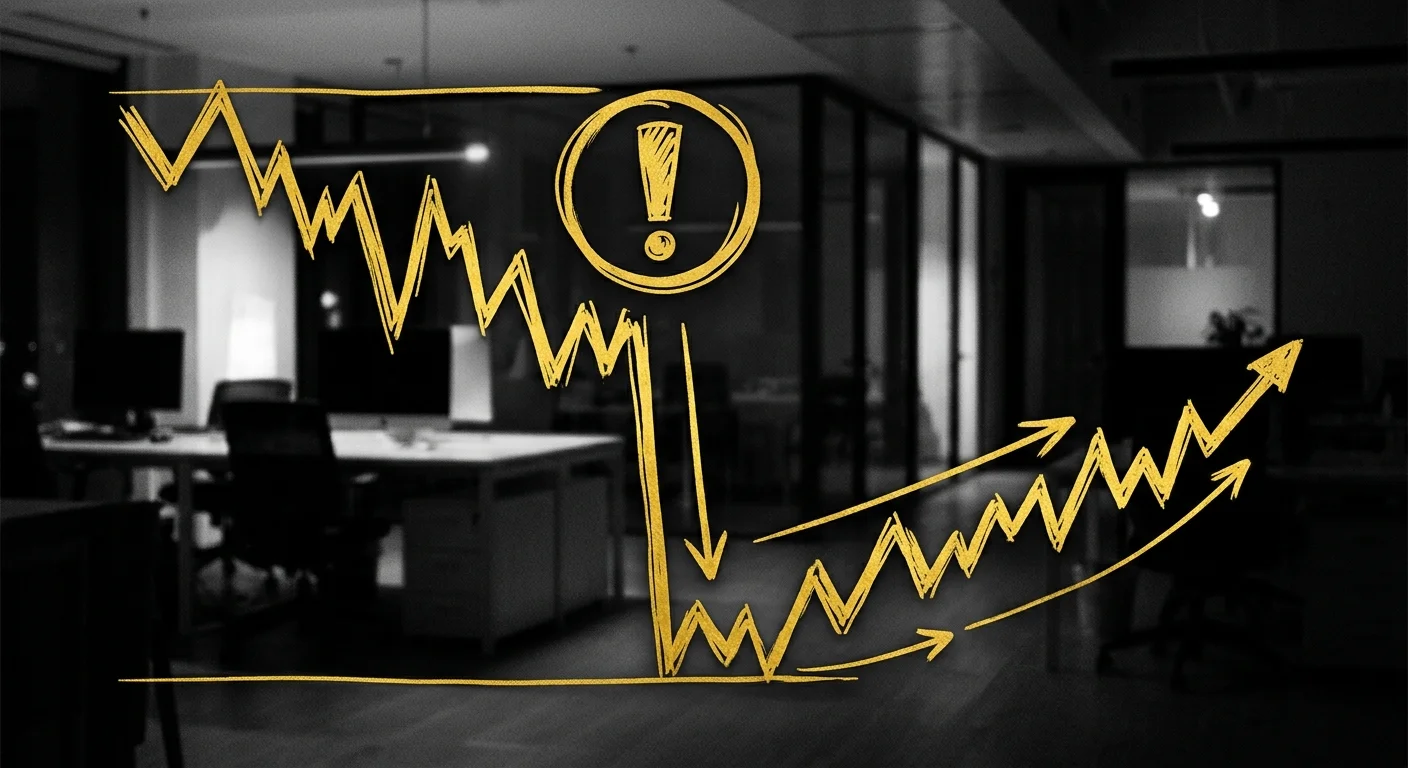
Reactive account management has a price tag.
It doesn't spread evenly across the quarter. It concentrates — into acute windows where the brand is effectively offline while the channel keeps charging fees, losing ranking, and bleeding margin.
Businesses that rely on containment instead of structural prevention absorb higher systemic losses. Amazon doesn't soften that rule — it amplifies it. A compliance failure here doesn't pause while you work on reinstatement. The consequences run on their own schedule, whether you're watching or not.
The damage hits in two waves. The first is obvious: revenue stops the moment a listing is suppressed or an account is suspended. The second wave is quieter — and worse. Ranking deterioration and operational decay keep running long after reinstatement.
Most brands account for the first wave. Almost none account for the second.
Revenue Losses During Suspension and Suppression Windows
When a listing is suppressed or an account is suspended, the revenue impact isn't gradual. It stops. And reinstatement for major compliance issues takes days to several weeks — not hours.
For mid-market brands, average daily revenue losses during suspensions often reach tens of thousands of dollars. That's not a worst-case scenario. That's the documented middle of the distribution.
A brand running a healthy Amazon channel before the suspension is running a zero-revenue Amazon channel the day after — with fixed operational costs still accruing the entire time.
The brands that absorb this worst are the ones who never saw it building. The violation log was accumulating. The policy flag was compounding. By the time the suspension notice arrived, the question wasn't whether the damage had happened — it was how long reinstatement would take.
None of that is inevitable. It's the direct result of operating without an active monitoring cadence.
The Inventory and Ranking Damage That Outlasts the Crisis
Here's what most brands miss entirely: the crisis window isn't the full cost.
It's the opening chapter.
Over 50% of active marketplace sellers identify supply chain disruption as a critical threat to sales continuity. Prolonged stockouts don't just pause revenue — they cause a persistent loss of organic ranking that requires significant ad spend to recover. That ranking doesn't reset when inventory comes back.
It has to be rebuilt at real advertising cost, on top of the revenue already lost during the outage. Jungle Scout's State of the Amazon Seller report documents this pattern consistently across seller categories and account sizes.
Leaning on last week's dashboard is how brands walk into next week's crisis. The account looks fine on the numbers you have. The ranking erodes on numbers you're not tracking. Over-reliance on historic performance metrics leaves brands blind to impending operational and regulatory changes — and that blindness is expensive.
Systemic corporate risk-assessment protocols exist for exactly this reason: reactive containment costs more than proactive prevention. Amazon channel management is where that principle shows up in real P&L terms, every quarter.
| Reactive Event | Immediate Revenue Impact | Recovery Timeline | Downstream Channel Cost |
|---|---|---|---|
| Account suspension (compliance violation) | Revenue drops to zero immediately — channel goes dark while fixed operational costs continue accruing | Days to several weeks for reinstatement on major compliance issues | Organic ranking erodes during outage and must be rebuilt with additional ad spend after reinstatement |
| Listing suppression (policy flag or content violation) | Average daily revenue losses often reach tens of thousands of dollars for mid-market brands | Variable — begins the moment the listing is suppressed, compounds until reinstatement is complete | Buy Box share lost during suppression is not automatically recovered — competitors gain positioning that persists |
| Prolonged stockout (inventory health failure) | Active sales volume drops to zero on affected ASINs; advertising spend continues generating impressions with no conversion | Inventory restocking timeline varies — but ranking loss begins accumulating from day one of the stockout | Persistent loss of organic ranking requires significant ad spend to recover — rebuilding costs exceed the prevention investment |
| Reactive crisis management posture (systemic) | Higher total losses across all acute compliance and operational events — containment is structurally more expensive than prevention | No fixed timeline — each reactive event restarts the damage cycle independently | Over-reliance on historic performance metrics leaves the account blind to impending operational and regulatory changes |
What Full Channel Management Monitoring Looks Like in Practice

Proactive monitoring isn't a philosophy. It's a process — weekly cadence, four signal categories, and decisions coming out the other end. Not reports. Decisions.
Most brands have seen the reporting decks. ACoS summaries. Weekly campaign breakdowns. What they've never seen is the operational layer underneath — the one that keeps those metrics from becoming irrelevant overnight. That layer is where proactive monitoring lives. And most agencies never show it to you because they're not running it.
This isn't about outsourcing a task. It's about installing infrastructure your internal team was never built to run at the required frequency and depth. The gap between what they can sustain and what the channel actually demands is where the P&L leaks — quietly, consistently, and in ways that won't show up on last month's dashboard. the hidden costs of in-house management
The Four Operational Pillars of Proactive Account Health
Full channel monitoring runs across four pillars: compliance integrity, listing health, brand protection, and inventory discipline. None are optional. None operate in isolation.
Compliance integrity starts with the Account Health Rating (AHR) — tracked weekly, not quarterly. A rating of 200 to 1,000 is Healthy. Scores from 100 to 199 are At Risk. Anything under 100 is Unhealthy and subject to immediate suspension. That's not a policy footnote. That's the operating threshold that determines whether the channel is open or closed.
Listing health covers content integrity, suppression flags, and policy violation counts. Brand protection monitors unauthorized seller activity and Buy Box ownership. Inventory discipline tracks in-stock rate, IPI score, and FBA storage utilization. What makes these a system instead of a checklist is the integration — reviewing these signals together, not in isolation, is what systemic supply chain monitoring protocols show reduces unexpected operational downtime by up to 45%. Review them separately and you're just collecting data. Review them together and you're actually running the channel.
How Inventory Health and Ad Spend Connect to AHR
Inventory health and advertising efficiency aren't parallel tracks. They're the same track.
When in-stock rate drops, organic ranking erodes. When ranking erodes, ad spend required to maintain visibility increases. When ad spend increases against a shrinking organic base, TACoS climbs — even as ACoS looks controlled. The account is running harder and producing less. And the standard agency reporting deck won't surface that relationship. It was never designed to.
The AHR score is the compliance signal. The IPI score is the inventory signal. Ad efficiency is the output signal. All three move together — so all three need to be reviewed together, in the same session, against the same week. What Is an Agency Operating Cadence? A Week in the Life of Your Managed Amazon Channel shows exactly how that weekly rhythm works in practice — not in three separate monthly reports from three separate teams.
Brand Protection as a Non-Negotiable Monitoring Layer
Brand protection is not a supplemental service. It's a monitoring layer that runs every week — because the threat it guards against is active every week.
Over 100,000 brands now use proactive brand protection monitoring tools to detect and report intellectual property violations before they compound. That number exists for a reason. Unauthorized sellers don't announce themselves. They appear, they win the Buy Box, and they start training your customer to expect a lower price — often before you have any visibility into what happened.
Unchecked hijackers cause immediate Buy Box loss and rapid average selling price erosion. But here's what most brands miss: that erosion doesn't reverse when the unauthorized seller is removed. The customer expectation has already been set. The price anchor has already shifted. Brand protection monitoring isn't something you activate after a hijack is discovered — it's the layer that prevents the hijack from completing in the first place.
| Monitoring Pillar | What Is Tracked | Proactive Action Triggered | P&L Impact if Ignored |
|---|---|---|---|
| Compliance Integrity | Account Health Rating (AHR) score, policy violation count, and pending enforcement flags | Violation log reviewed weekly; flags addressed before they compound into AHR degradation or suspension trigger | Listing suppression, account suspension, and full revenue stoppage — with reinstatement timelines that stretch days to weeks |
| Listing Health | Content suppression flags, keyword indexing status, and listing policy compliance across all active ASINs | Suppressed listings identified and resolved within the monitoring cycle before organic ranking begins to erode | Loss of search visibility, conversion rate decline, and increased ad spend required to compensate for organic indexing gaps |
| Brand Protection | Unauthorized seller activity, Buy Box ownership rate, and average selling price (ASP) relative to MAP policy | Unauthorized seller reports filed immediately upon detection; Buy Box reclaimed before pricing erosion sets in | Immediate Buy Box loss, ASP erosion that persists after removal, and customer price expectations that devalue the brand permanently |
| Inventory Discipline | In-stock rate, IPI score, FBA storage utilization, and inbound shipment lead time against forecasted demand | Reorder triggers and FBA replenishment timed to avoid stockouts before organic ranking is affected | Stockout-driven ranking loss that requires significant advertising investment to recover, compounding the original inventory cost |
Frequently Asked Questions
So that's the case for proactive monitoring. Now here's what brands actually ask before they commit to changing anything.
No hedging. No qualifications. Direct questions, direct answers.
What is the difference between proactive and reactive account health monitoring on Amazon?
Proactive monitoring intercepts problems before they surface. Reactive monitoring is what happens after they already have.
Here's what that looks like in practice. Proactive means reviewing the Account Health Rating (AHR) weekly — catching policy flag accumulation before the score drops below 200, resolving violations before they stack into suspension territory. Reactive means opening Seller Central after the suspension email arrives. At that point, reinstatement for major compliance issues can take days to several weeks.
The channel doesn't pause while you fix it. Revenue stops. Costs keep running. That's the P&L consequence of the gap — and it happens every time a brand finds out about a compliance problem the wrong way.
How does a drop in Amazon Account Health Rating (AHR) impact active advertising campaigns?
A declining AHR score doesn't stay in the compliance column. It moves straight into advertising performance.
When AHR drops into the At Risk range — 100 to 199 — the listings it covers become suppression targets. Suppressed listings don't receive ad traffic. Ad spend keeps accruing against impressions that convert at a fraction of the healthy baseline. Average daily revenue losses during suspensions reach tens of thousands of dollars for mid-market brands — and that figure doesn't include the ad budget burning against a broken funnel.
AHR and advertising efficiency are the same variable. An agency optimizing ACoS without monitoring AHR is adjusting one dial while the engine loses compression.
Why do most traditional marketing agencies fail to protect Amazon account health?
Because they weren't hired to. Traditional marketing agencies manage media spend and report on campaign performance. That's the scope of the engagement. Operational compliance, brand protection, inventory signals — those weren't in the contract.
So they don't get watched.
What you get is an account that looks healthy in the campaign dashboard while silently accumulating risk in every column the agency isn't covering. Unchecked hijackers cause immediate Buy Box loss and rapid average selling price erosion. Neither of those events shows up in a standard advertising report. The weekly deliverable looks fine. The channel is degrading. That's not a failure of effort. It's a failure of scope — and the brand pays for the difference.
What are the most common compliance risks that cause sudden listing suppression?
Four categories drive sudden listing suppression most consistently: policy violation accumulation, product compliance failures, listing content flags, and intellectual property complaints.
Policy violations move gradually. A single flag rarely causes suppression on its own — but an unmonitored violation log tips the AHR score below the Healthy threshold of 200 without any single dramatic event. By the time the score crosses below 100 into Unhealthy territory, the account is already subject to immediate suspension.
Content flags and IP complaints move faster. Over 100,000 brands now use proactive protection systems specifically because unauthorized sellers file competing IP claims and listing modifications that trigger suppression from the outside. The brand that isn't monitoring for those actions finds out about them after the listing goes dark — not before.
How does proactive operational discipline directly impact marketplace channel profitability?
Directly. And it runs in both directions.
When the channel is structurally sound — AHR in the Healthy range, listings compliant, inventory in stock — advertising spend builds organic equity. TACoS falls over time because organic velocity increases alongside paid performance. The investment compounds.
When the channel goes unmonitored, the reverse kicks in. Prolonged stockouts produce a persistent loss of organic ranking that requires significant ad spend to recover. That recovery spend doesn't build anything. It buys back the baseline the brand already held before the disruption. Proactive discipline is the difference between advertising that builds and advertising that treads water.
Can a brand manage account health monitoring effectively without a dedicated agency partner?
Some brands can. But the structural requirements are specific, and most internal teams don't meet all of them at once.
Effective account health monitoring requires a dedicated weekly review cadence running across compliance integrity, listing health, brand protection, and inventory discipline — simultaneously, not sequentially. It requires someone who knows what an AHR score of 150 means operationally, who has escalation access when a suppression flag appears, and who is accountable for the outcome — not just the report.
Most internal teams have the access. They don't have the cadence, the escalation infrastructure, or the accountability structure. Over 50% of active marketplace sellers already identify supply chain disruption alone as a critical threat to sales continuity — and that's one of four monitoring pillars. Running all four at the required depth and frequency is a full-time operational function. The brands that find out their team wasn't actually running it pay for that discovery in ways that don't show up on a single line item.
The Operational Shield Is Either On or Off
The fire alarm doesn't put out fires.
It tells you the building is burning before the damage becomes total. That's the only choice proactive monitoring offers — not whether the risk exists, but whether you find out about a problem before or after it costs you.
Every brand on Amazon is choosing one of those two positions right now. Most just haven't named the choice yet.
Most brands running without a structured monitoring cadence think they're in a third category — the one where nothing has gone wrong yet.
That's not a third category. That's what reactive looks like before the incident.
The absence of a visible problem is not evidence of a healthy channel. It's evidence of insufficient monitoring. When the suspension notice arrives — or the unauthorized seller wins the Buy Box, or the IPI score drops the account into restricted restock status — the shield wasn't missing in that moment. It was missing the whole time.
At Marketplace Valet, Marketplace Account Management is built around this exact principle: account health monitoring isn't a back-office function. It's the operational infrastructure that makes everything else worth protecting — advertising efficiency, listing performance, inventory discipline. TACoS only compounds in the right direction when the channel is structurally sound beneath it. Advertising investment only builds equity when the listings it drives traffic to are compliant, brand-protected, and in stock.
The shield is either on or off. There is no partial credit.
The question for brand leadership isn't whether your Amazon channel needs monitoring.
It's whether the person or team currently responsible for it is actually accountable for the outcome — or just accountable for the report.
If you don't know the answer to that with certainty, the shield is off. And the cost of finding out reactively is documented, measurable, and entirely avoidable.
So here's the question every brand in this position eventually faces: do you find out about the gap before it costs you, or after? A free Amazon account audit answers that. Compliance risk, listing integrity, brand protection gaps, inventory discipline — reviewed as one complete operational picture, not four separate conversations with four separate reports. It's a 15–20 page review of your specific account, delivered within 3–5 business days. The findings are yours regardless of what comes next. Get a Free Amazon Audit.